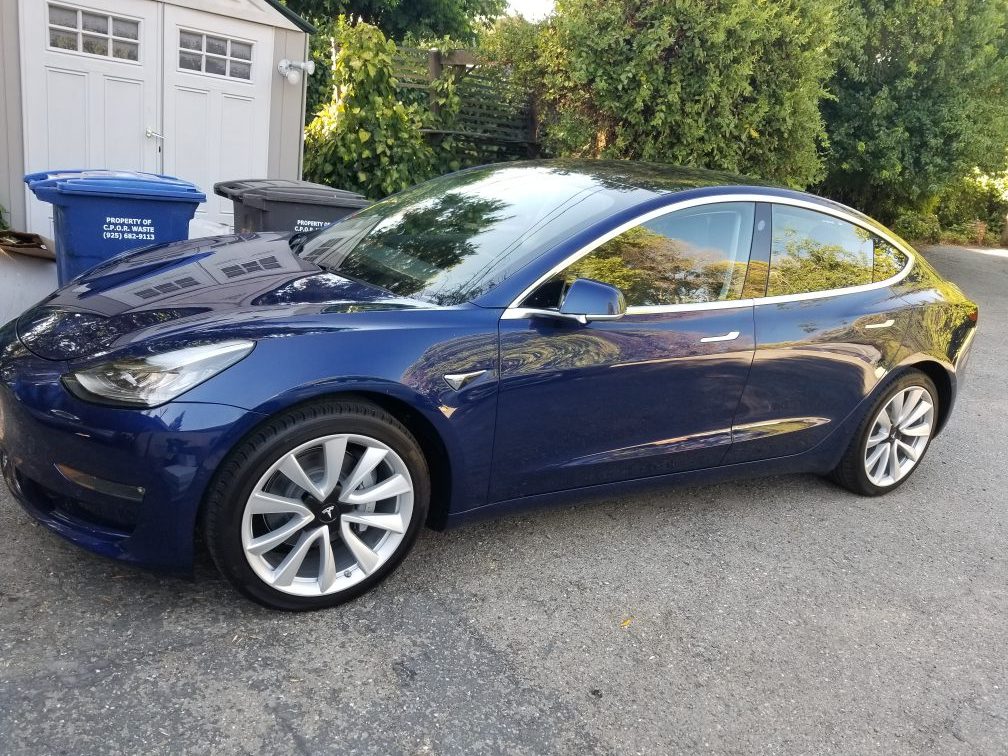
My car is not sleeping – now fixed

see below for an update to this post

Since the 2020.24.6.1 software that Tesla pushed to my Model 3 in late June, my car has not been sleeping correctly. I know this because of the before and after data that TeslaFi (a 3rd party app I use) showed me right away after the update that my car was not sleeping.
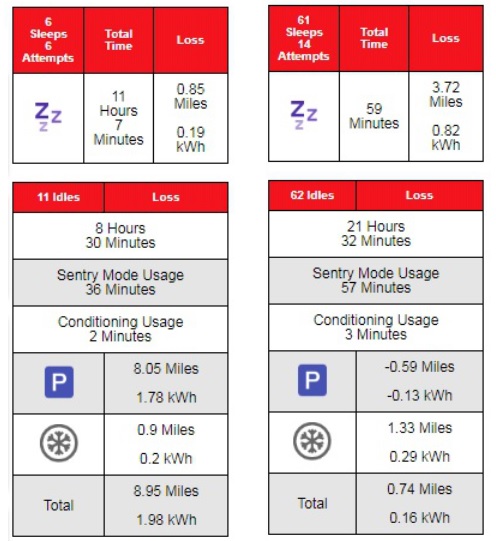
Typical day Before and After the 2020.24.6.1 software release

What is TeslaFi? It’s a cloud based server side data logger which amasses data from my car, you see, Tesla provides an API which which gathers and aggregates data you can use to understand the energy use and recharging times and costs, showing, over time, the dreaded battery degradation, knowing when the car is awake vs asleep, alerting if the car is left unplugged or a window is down for more than x minutes, tracking mileage if you need it for business or tax reimbursement, tracking the car if used by other people (i.e. kids)

Since the TeslaFi data was showing the car mostly in idle throughout the night instead of asleep, along with the corresponding higher battery consumption during the night, I put a ticket into Tesla, got a mobile ranger out to my house, and he plugged in and found API requests from a 3rd party every minute. Well that sounded like TeslaFi, but I hadn’t worked enough with the TeslaFi support staff to understand exactly how TeslaFi dealt with the sleeping mode of the car. I had explained to the ranger that I had disabled TeslaFi (and other apps) by changing my user/pass which invalidates API tokens, but he explained that sometimes the tokens don’t really become invalid. I understood that checking the “vehicle list” in the API doesn’t come to the car, but it looked like it was now. Only I should have asked, why just my car? Many TeslaFi users should have been complaining about this.* My ticket with Tesla was closed but I then worked with TeslaFi support and found out so much more about how they behave and interact with the car. Tesla shouldn’t have really dismissed this (and I suspect others) as a well known “app” which keeps pinging the vehicle, thus keeping it awake.

What I know now, having not only removed all 3rd party API use, removed user/pass from my own Tesla app, removed the app, even moved the car to “not my garage” so the WiFi and LTE environment is different, is that something is waking the car, usually just after it goes to sleep. This is what TeslaFi was reporting to me right after the 2020.24.6.1 software release. Frankly, while my configuration settings were not “perfect”, they shouldn’t have been contributing to this situation. Common sense would dictate that something changed with the software release, because the behavior of the car changed. And I should have been more insistent.

So, I have a new ticket open with Tesla, I’ll have to have a ranger hook up to the car again, only this time, I’m armed with a specific API request for this “vehicle list” which I can invoke from a web browser. E.g., we can do an experiment, where I can invoke the API, he can see it or not. My expectation is he won’t be able to see it, thus proving or disproving the point that Tesla has been making all along, that 3rd party apps, if you use them, are the problem.

Part of why I believe this is not the case now is that TeslaFi and I put the car into a very long interval polling mode where API requests were done at 20 minute or longer intervals, and the car should be asleep for those, especially in the middle of the night (you see, normally I have it configured to allow “deep sleep” mode where from 11pm to 6am, no vehicle interaction is done.) So at 6:01am I should normally find the car asleep, but as I say, this has not been the case. Even in my everything has been removed situation, the underlying question is why is the car losing 6-10% of charge overnight? Because it’s in IDLE, obviously, but why?

Update August 2020 – A Tesla Mobile Ranger replaced my autopilot computer because they saw Ethernet port errors in the logs. Unfortunately, this did not resolve the sleeping issue when he left and the car had 24 hours to “do it’s thing”.

Update later in August 2020 – a Service Center visit resulted in a sensor in the driver’s seat being replaced. This was the Driver Occupancy Sensor. Like the autopilot computer, this did not resolve the issue. They have ordered a new seat for me, believing the wiring harness is the issue. One would think this is easy to test, driver in the seat, driver not in the seat…

Later – Well, the seat replacement did not fix this and I took the car back. It’s September now, and I’m pondering what to do, because after the seat replacement failure, Tesla investigated further and simply said, it’s a 3rd party app, but we don’t know which one…

Thinking further on this, I think I had mistakenly left Teslafi on for my account, which also has a Model Y on the account, no problems sleeping there… Anyway, I think they see the vehicle list API request at the account level and simply say, it’s a 3rd party app, you figure it out. So, what I really needed to do was disable Teslafi at the account level, both cars, and then see what they say.

So, I’ve done this, for 5 days (disabled both Teslafi accounts, pointing at the same Tesla account) and provided detailed dates, times, specific repairs, etc. to a very helpful support person who forwarded the whole mess to Advanced Engineering. I heard back from them last week (Oct 15) and they want to have to car back so they can look again, something in the hardware is obscuring what is happening in the car. So, I bring it on Oct 23, with Teslafi completely disabled, both cars, and we’ll see what gives.

Late October – so, hopefully, I’ve got a conclusion now… After 2 weeks, the car is sleeping. Tesla Service Center replaced a voltage controller for the driver’s seat. It was periodically dropping voltage to the seat occupancy switch. This appears to solve the problem, car now going to sleep on its own. Previously they replaced the switch and the entire seat suspecting the wire harness, but neither was not the solution. Tesla advanced engineering was instrumental in resolving this. I had to provide them, through support, with a very exhaustive list of actions taken prior to this.

* A few TeslaFi users are complaining about strange sleep patterns and it seems very similar to my own situation, but going back to the end of 2019 and certainly on other software releases. There have been issues with “hot” rear cameras (energy usage) and HV Battery firmware questionable behavior, but I think we’ve not yet seen the end of this. I asked some of these users if they had two cars and I’ve gotten 3 “bites” so something is going on with this commonality. Notice below, the Model 3 is online and the Model Y is Asleep. The other users all say the first entry, the older car, AMP in my case, is the one not sleeping.

Vehicle List API response: Array ( [response] => Array (

[0] => Array ( [id] => 32847053162823755 [vehicle_id] => 438746238 [vin] => 5YJ33333333333333 [display_name] => Amp [option_codes] => AD15,MDL3,PBSB,RENA,BT37,ID3W,RF3G,S3PB,DRLH,DV2W,W39B,APF0,COUS,BC3B,CH07,PC30,FC3P,FG31,GLFR,HL31,HM31,IL31,LTPB,MR31,FM3B,RS3H,SA3P,STCP,SC04,SU3C,T3CA,TW00,TM00,UT3P,WR00,AU3P,APH3,AF00,ZCST,MI00,CDM0 [color] => [access_type] => OWNER [tokens] => Array ( [0] => 17a9f08445f2214c [1] => c91a61248ca6580d ) [state] => online [in_service] => [id_s] => 32847053162823755 [calendar_enabled] => 1 [api_version] => 10 [backseat_token] => [backseat_token_updated_at] => [vehicle_config] => )

[1] => Array ( [id] => 31695657956927095 [vehicle_id] => 2130063041 [vin] => 5YJYYYYYYYYYYYYYY [display_name] => Volt [option_codes] => AD15,MDL3,PBSB,RENA,BT37,ID3W,RF3G,S3PB,DRLH,DV2W,W39B,APF0,COUS,BC3B,CH07,PC30,FC3P,FG31,GLFR,HL31,HM31,IL31,LTPB,MR31,FM3B,RS3H,SA3P,STCP,SC04,SU3C,T3CA,TW00,TM00,UT3P,WR00,AU3P,APH3,AF00,ZCST,MI00,CDM0 [color] => [access_type] => OWNER [tokens] => Array ( [0] => 74952f4bcd414992 [1] => 7b24edad1afecc5f ) [state] => asleep [in_service] => [id_s] => 31695657956927095 [calendar_enabled] => 1 [api_version] => 10 [backseat_token] => [backseat_token_updated_at] => [vehicle_config] => )

) [count] => 2 )
Tesla Stops Itself

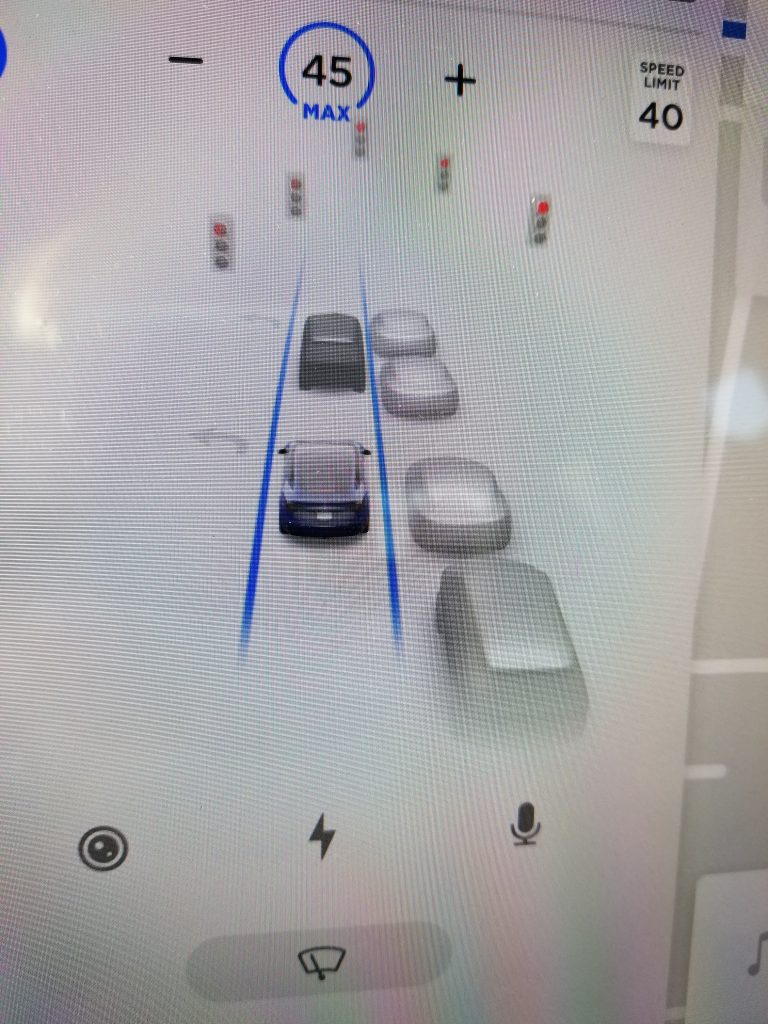
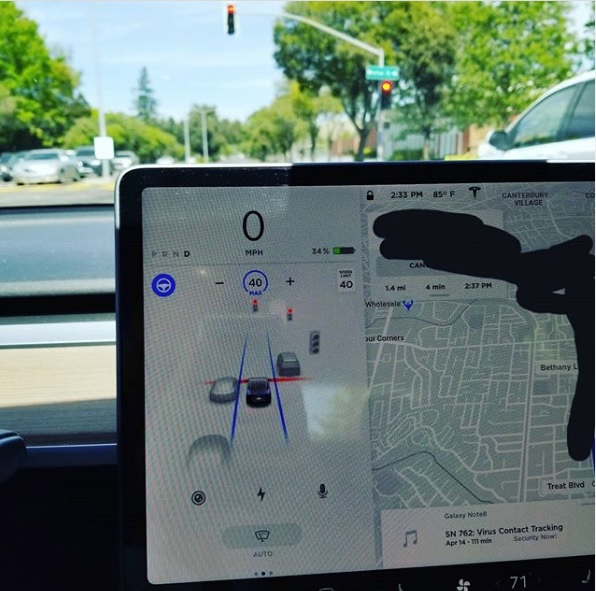
A recent software update (2020.12.6) for my Model 3 has added the capability for the car to stop itself at stop lights and stop signs. Actually, for traffic light controls it currently slows down for all lights; red, yellow, green, but I can signal for it to continue thru green lights in advance of it slowing to a complete stop. (a later update allows the car to follow other cars through green lights without driver interaction) Once a red light changes to green, pushing down on the control stalk or pressing the accelerator (intuitively) signals to the car to continue on, up to the speed limit of the road.

Some people find this annoying (always telling the car to go ahead), but what Tesla owners are all doing collectively is training a neural net so that all conditions for these traffic controls can be trained into the neural net. What is also annoying is the other drivers… my car is doing the speed limit of the road throughout all of this, and everyone is honking and speeding by me, at least by 5 mph, often higher. IF I’m in the right lane, what is it that allows you as a fellow driver, concerned for your and my safety, to be so insistent that honking to “get out of the way” in the right lane is the correct behavior?

If you have indicated to go ahead and a light changes from green to yellow to red, then the car will instead stop itself. And, if you are behind another car, just like before, the car will keep it’s follow distance from that car.

The technology involved here, I believe, is outstanding. Eventually, for a full self driving capability, this training will not be necessary, but right now it’s a beta version of stopping for traffic controls and it does the job. Of course, as the operator of the vehicle, you still have to keep your hand on the wheel and be ready to take over if something unforeseen occurs.

FSD 3.0 Hardware

Monday, Tesla finished the upgrade of my 2.5 autopilot hardware on my Tesla Model 3. It’s still not ready for “feature complete” aspects of the Full Self-Driving (FSD) software, which is due shortly, but at least my hardware is now in place.

Right now, I can see that it “sees” stop lights, signs, traffic cones, etc. Autopilot seems a lot more responsive while I drive. The new CPU’s in this computer are clocking a lot less utilization than the Nvidia CPU’s in the previous hardware.

Last week, when I had my Model3 into Service Center for HW 3.0 update, coincidentally, another owner’s Model3 was in for the update same day as mine, and the vehicle ID numbers (VIN) were switched. It was an honest mistake by the technicians involved. The VINs were very similar to each other, ending in 420 vs. 042. So think about those odds: two techs, two similar VINs, same SC…

Anyway, afterwards, my car would not get any software over the air (OTA), it was reporting the wrong color and the wrong tire size, wrong odometer, and my phone/app would not pair to car to act as a key to the vehicle. I discovered the VIN issue with Tesla over the phone help on 2/21, but it could not be resolved via OTA. So another service visit (the next working day) was necessary for correct VIN to be put into my car.

I did not catch this myself when picking up on Friday, only after I was home and car was not getting it’s OTA updates and subsequent phone call analysis. Somewhere during this diagnosis I thought VIN did not “look right” and on the phone, the tech confirmed it by having me check the VIN under the windshield and on driver door jam.

I think now an additional step in the HW 3.0 install process will be to confirm VIN’s before finishing up and returning the car to the customer. Tesla called the other customer to have them return for service to his car. He had noticed wrong car color on his screen, but not yet taken any action yet.

Go figure…

Enhanced Summon

Yesterday, on Sept 27, my vehicle was updated with the Version 10 software, in which is contained the updated “Summon” software, known as Enhanced Summon.

In the parking lot or garage scenario, the car will come out of it’s parked location, opening the garage door, if necessary, and travel, slowly, to the location you indicate, such as the doorway of a nearby building (in the rainy day example of “Why do I need this?”).

Tesla Model 3

Indeed, my car will do this, having tested it out after getting chinese food last night. I think the lady in the SUV behind my car was a little surprised, because she didn’t realize that there was no driver in the car in front of her! And then I got in.

We live in amazing times.

updated 10/3: There are many many youtube and other mentions of people trying this out, some of them very stupid. It’s a beta feature and it should be tried with caution and attentiveness, this is still not Full Self Driving. But then there are always going to be people pushing the envelope to the crazy side, right?

Americans are not interested in electric vehicles

This statement may be a shocker to you, unless you are part of the subset of Americans that fall into this category. Many of you probably know I bought a Tesla Model 3 over a year ago, and I’ve loved every minute with it, even with some very small issues.  Those were fixed really quickly by the customer service center or the mobile rangers. But there is a recent Forbes article with much the same headline as above and they go into a bunch of stats and arguments about how people don’t like to change. That is why no love in the EV space.

Recent Event

Today I want to write about a recent experience with another Tesla owner, not a bad experience, but upon reflection, perhaps an indication of the human condition.

I had recently purchased a glass roof sunshade which further cuts the infrared radiation coming into the cabin on my Model 3 (search for “BougeRV Tesla Model 3 Glass Roof Sunshade” on Amazon). It was easy enough to put in, it simply works, I’ll probably take it down for the winter months (it folds up nicely), so I can look out the glass roof from time to time. Many have written about the roof in this car, a technology milestone on it’s own.  The roof does an amazing job with cutting the radiation, I just wanted to have it cut some more, make it easier for the AC. The company I bought the sunshade from, BougeRV, provided me with a gift, unsolicited. A set of cup holder and center console inserts, but I had already purchased these a while ago. They are removable (for cleaning) and protect the cupholders from crumbs, condensation from glasses, and generally make clean up easier. Like I said, I already had some.

A couple of days later I saw another Telsa Model 3 in a parking lot where I used to work. Maybe you can guess what’s going to happen next. Once I saw he did not have any cup holder inserts of his own, I left a note on one of my old business cards. He called, I drove over, he saw my car, he looked at the inserts and he bought them for a whole $7.00. Wow, like, right?

Knowledge

is power, I know. But what has struck me about both the Forbes article and the reaction of this former co-worker is that people just don’t understand what they have or could have in this technology that has 4 wheels.

Yes, its a bit of a joke, I think other people like the joke, too, about Tesla’s are not cars, they are computers with wheels.

Forget the basic high value of the car itself, what my co-worker did not understand that they are a lot of options in the accessory market that can improve your experience with your Model 3 (or X or S). Many people don’t even know how to operate all of it’s features.

The people in the Forbes article that are not interested in electric cars, they don’t understand how they can get a better car, a safer car, a better experience, for less than they are going to pay whichever Japanese car maker. I’ve even had one person on a road trip that came over to look at my car, tell me they don’t like Tesla cars because they are not an American car. 

It’s really hard to argue with people like this.

When I bought this car, I sought out knowledge about the car, about the technology. I also found people were 3-D printing accessory parts, for security clips, for phone chargers, lots of things. Maybe I am an outlier and the statement should really not be “Americans are not interested in electric cars” but rather “Americans are not interested in knowledge.” — Even if you are plunking down tens of thousands of dollars for an automobile.

And to that point, I don’t know what to say.

P.S. for the “for less” point above, here is some extra reading for your research “https://cleantechnica.com/2019/06/22/toyota-corolla-vs-tesla-model-3-5-year-cost-comparison/

P.P.S. there is a referral program, use this link and you can earn 2,000 miles of free Supercharging with the purchase of a new Tesla car delivered before October 1, 2019, https://ts.la/thomas44545 . I can get some miles too. The referral program changes from time to time, sometimes it goes away for a bit, so it may be different than what’s noted here. There is a referral incentive for solar on your roof as well.